
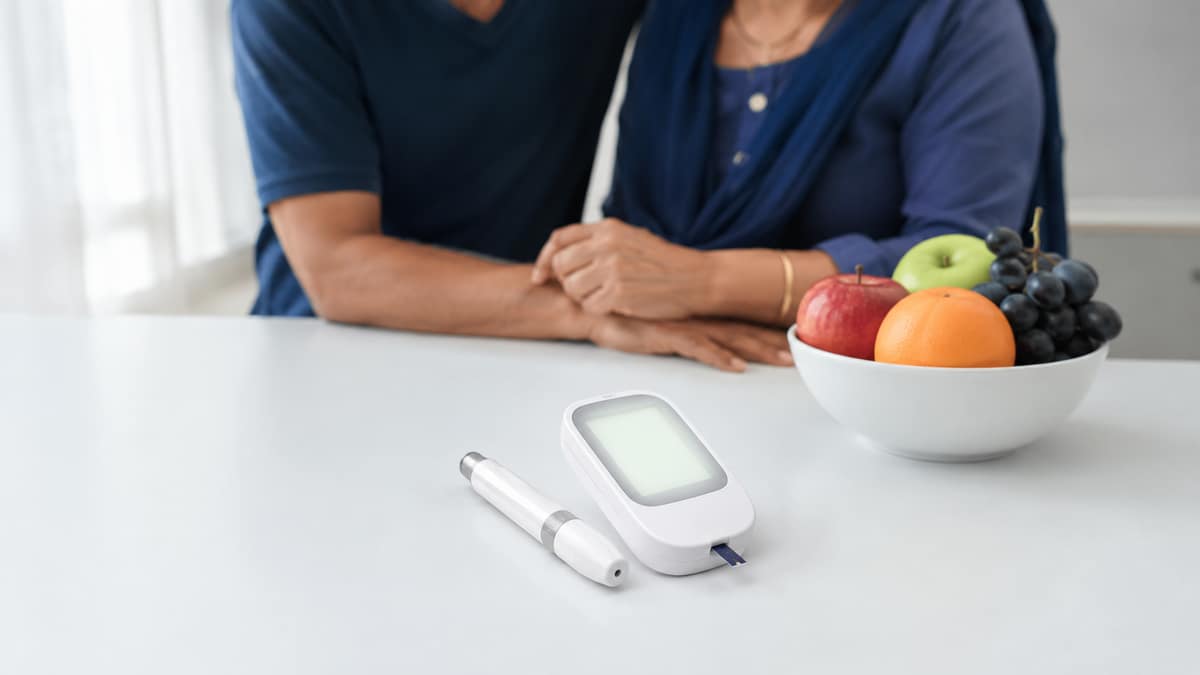
Two people can have an identical fasting sugar of 105 mg/dL and completely different diabetes risk. The difference shows up in a test that does not care what they ate this morning.
Three tests, three questions
Fasting blood sugar (FBS)
Glucose after 8 to 12 hours without food. It answers: where does my sugar settle when nothing is being digested? A single photograph — accurate, and only of that moment. It moves with last night's dinner, a poor night's sleep, an infection or the stress of the appointment itself.
Post-prandial sugar (PPBS)
Glucose two hours after a meal. It answers: how well does my body clear a load of sugar? Post-meal values often rise years before fasting values do, which is why a normal FBS alone can be falsely reassuring.
HbA1c
Glucose attaches slowly and irreversibly to haemoglobin inside red blood cells. Because those cells live roughly three months, the percentage of haemoglobin carrying sugar reflects your average glucose over the previous 8 to 12 weeks, weighted towards the most recent few. It answers: what have my sugars actually been doing since the last visit?
No fasting is needed, the time of day does not matter, and a careful week before the test cannot rescue a difficult three months.
The thresholds doctors use
| Test | Normal | Prediabetes | Diabetes |
|---|---|---|---|
| Fasting glucose | Below 100 mg/dL | 100 – 125 mg/dL | 126 mg/dL or above |
| 2-hour glucose (OGTT) | Below 140 mg/dL | 140 – 199 mg/dL | 200 mg/dL or above |
| HbA1c | Below 5.7% | 5.7 – 6.4% | 6.5% or above |
These are the widely used international criteria, and they come with an important qualification: a diagnosis of diabetes is not made on one number. In the absence of clear symptoms, an abnormal result is confirmed on a repeat test before anyone is labelled diabetic. That confirmation is your doctor's call, and it is worth insisting on.
When HbA1c misleads
HbA1c measures haemoglobin, so anything that changes the life of a red blood cell changes the result — without your sugars having moved at all.
It can read falsely low when red cells are being replaced faster than usual:
- Recent blood loss or blood transfusion
- Haemolytic anaemia
- Pregnancy, particularly the later months
- Iron or B12 deficiency that has recently been treated
It can read falsely high when red cells live longer than usual — untreated iron-deficiency anaemia is the common one in India — and in advanced kidney disease.
Haemoglobin variants such as thalassaemia trait, HbE and HbD deserve their own mention. They are not rare on the subcontinent, and depending on the analyser they can shift an HbA1c result in either direction. If your HbA1c and your glucose readings persistently disagree, this is one of the first things a doctor will consider, and it is a reason to lean on fasting and post-meal glucose instead.
So which should you do?
In practice, not one or the other:
- Screening a healthy adult: a fasting sugar, with HbA1c added when there is a family history, weight around the abdomen, high blood pressure, PCOS, or a history of gestational diabetes.
- Already diagnosed: HbA1c every 3 months while treatment is being adjusted, and roughly every 6 months once you are stable and at target.
- Anything confusing: fasting and post-meal glucose alongside HbA1c, so a discrepancy shows itself rather than hiding.
The tests that belong beside it
Diabetes is a blood-vessel disease as much as a sugar one, and sugar alone is an incomplete picture. Reviewed at least once a year, usually together:
- Lipid profile — cholesterol and triglycerides
- Kidney function — creatinine with eGFR, and urine albumin-to-creatinine ratio, which detects kidney involvement early enough to act on
- Liver function — fatty liver frequently travels with insulin resistance
- Blood pressure, weight and a dilated eye examination — not laboratory tests, and no less important
Our health packages group these together, and the individual tests are listed under diabetes care and monitoring. If travelling for a fasting sample is difficult, home collection is available across Surat.
A number on a report is not a verdict. HbA1c is the most honest single number in diabetes care because it is the hardest to prepare for — but it is still one input into a decision your doctor makes with you.
- Diabetes
- HbA1c
- Blood sugar